Too Good to Be True: When Directors and Managers Become Personally Liable in Portugal
Understand where limited liability ends, personal exposure begins, and how sound governance can protect decision-makers.
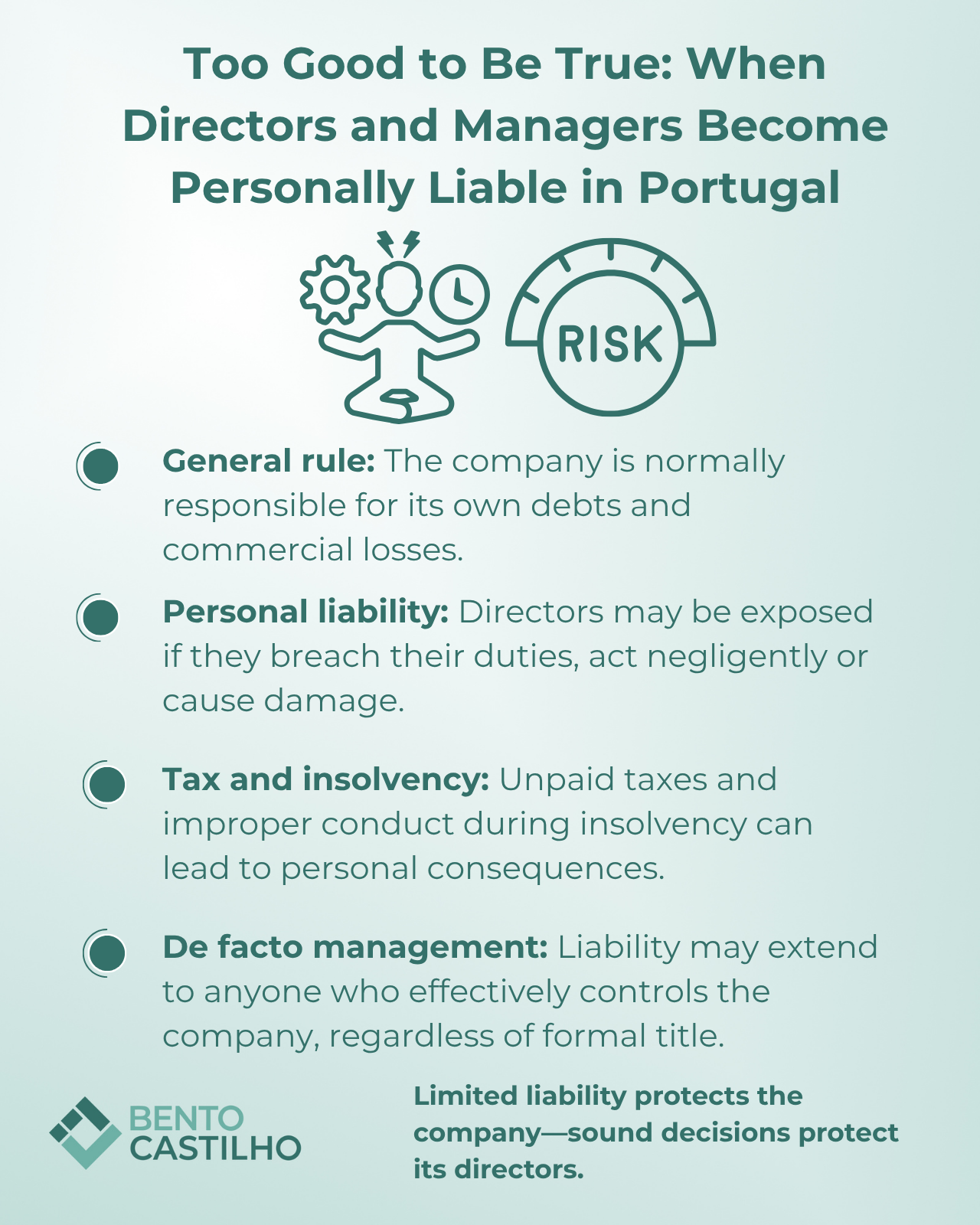
Too Good to Be True: When Directors and Managers Become Personally Liable in Portugal
Limited liability is one of the principal advantages ofoperating through a company. But the protection belongs primarily to theshareholders—it is not an absolute shield for the people managing the business.
The starting point is simple: the company is normally responsible for its own debts and obligations. Directors and managers do not become personally liable merely because the company loses money, fails to pay a creditor or makes an unsuccessful business decision.
Personal liability usually requires something more: a breachof duty, fault, damage caused to another person or the application of aspecific legal regime, such as tax liability or culpable insolvency.
The central distinction runs throughout each of these areas:a poor commercial result is not automatically misconduct. What mattersis whether the director or manager acted lawfully, loyally, on an informedbasis and with a rational business purpose.
1. Duties owed to the company
Portuguese Law requires directors and managers to act withcare and loyalty.
The duty of care means that they should:
- Obtain sufficient information before deciding;
- Understand the main risks;
- Consider reasonable alternatives;
- Monitor the company’s financial position; and
- Act with the competence and diligence expected from someone in their position.
The duty of loyalty means that they must act in thecompany’s interests rather than favouring themselves, a particular shareholderor a related business.
Personal liability may arise when a breach of these dutiescauses damage to the company. Examples include approving an obviously harmfulrelated-party transaction, ignoring serious financial information or usingcompany assets for an improper purpose.
However, liability should not arise merely because a properly considered business decision later proves unsuccessful. Portuguese company law recognises the importance of decisions made on an informed basis,without a personal interest and according to rational business criteria.
2. Liability to creditors and third parties
Directors and managers do not normally guarantee thecompany’s debts.
However, Portuguese law allows creditors to pursue directors or managers when a culpable breach of rules intended to protect creditors causes the company’s assets to become insufficient to pay them.
This may be relevant where management:
- Removes or conceals company assets;
- Transfers assets below market value;
- Favours related parties improperly; or
- Carries out transactions that unlawfully weaken the company’s ability to pay creditors.
Directors and managers may also be liable for damage caused directly to shareholders or third parties while performing their functions.
The distinction is important: a creditor cannot normallypursue a manager simply because the company has failed to pay. There must be aseparate legal basis for personal liability.
3. Tax and Social Security debts
Tax debts are one of the most important exceptions to thegeneral rule of limited liability.
Portuguese Tax Law allows tax debts to be enforced subsidiarily against directors, managers and anyone who exercises management functions in practice.
Liability depends on factors such as:
- Whether the person actually exercised management;
- When the tax obligation arose;
- When the payment deadline ended;
- Whether the person was in office at the relevant time; and
- Whether the failure to pay or the insufficiency of company assets was attributable to that person.
A formal title is not always decisive. Courts examine whoactually controlled payments, bank accounts, employees, contracts andcommunications with creditors or authorities.
Unpaid Social Security contributions also require urgentattention. They do not automatically make every director personally liable, butthey may lead to enforcement and may indicate that the company is approachinginsolvency.
4. Responsibility during insolvency
A company’s insolvency does not automatically make itsdirectors or managers personally liable.
The risk increases when management fails to reactappropriately or contributes to worsening the company’s financial position.
High-risk conduct includes:
- Concealing or improperly disposing of company assets;
- Artificially increasing liabilities or losses;
- Using company assets for personal or related-party benefit;
- Continuing loss-making operations for personal or third-party benefit when insolvency is highly probable;
- Serious accounting failures; and
- Failing to apply for insolvency within the applicable deadline.
Therefore, continuing to trade during financial difficulty is not automatically unlawful. The risk begins when there is no credible recovery basis, the interests of creditors are improperly disregarded or management delays necessary action without a defensible reason.
5. De facto directors and managers
Personal liability is not limited to people formally registered as directors or managers.
A de facto manager is someone who exercises effective management powers without formally holding the position.
Evidence may include:
- Authority over company bank accounts;
- Instructions given to employees;
- Decisions concerning payments;
- Negotiations with creditors;
- Contract signatures; and
- Actual control over business strategy.
A person cannot necessarily avoid responsibility by managing the company informally or through another registered officeholder.
How can directors and managers reduce their exposure?
The most effective protection is a clear and documented decision-making process.
For important or high-risk decisions, management should record:
- The information reviewed;
- The company’s financial position;
- The alternatives considered;
- The principal risks;
- Any conflicts of interest;
- The commercial rationale;
- The final decision; and
- When the decision will be reviewed.
During financial distress, management should also maintain:
- A rolling 13-week cash-flow forecast;
- An updated list of debts and payment deadlines;
- A record of negotiations with creditors and authorities;
- Written criteria for prioritising payments;
- Current and reliable accounting records; and
- Regularly documented management meetings.
Documentation does not make an unlawful decision lawful. Itdoes, however, help show that management acted carefully, rationally andwithout improper interests.
The practical boundary
A director’s or manager’s responsibility generally ends where they have:
- Acted within their legal powers;
- Obtained appropriate information;
- Considered the relevant risks and alternatives;
- Managed conflicts of interest;
- Chosen a rational course in the company’s interests;
- Monitored the outcome; and
- Responded promptly to signs of insolvency.
Personal responsibility is more likely to begin where there is:
- A breach of duty;
- Personal or related-party benefit;
- A failure to act on obvious warning signs;
- Unexplained or selective payments;
- Misuse or concealment of assets;
- Serious accounting failures;
- Fault connected with unpaid tax liabilities; or
- Intentional or grossly negligent conduct that creates or worsens insolvency.
When should legal advice be obtained?
Legal advice should be sought promptly when
- Taxes, Social Security contributions or salaries remain unpaid;
- The company cannot meet several obligations as they fall due;
- Management is considering selective payments;
- A major asset sale or related-party transaction is proposed;
- Creditors have started enforcement proceedings;
- The company is continuing to trade without a credible recovery plan; or
- There is uncertainty about the insolvency filing deadline.
Early advice can help distinguish a difficult but legitimate business decision from conduct that may create personal liability.