All Form, No Substance? Substance Matters
Economic substance in international tax law
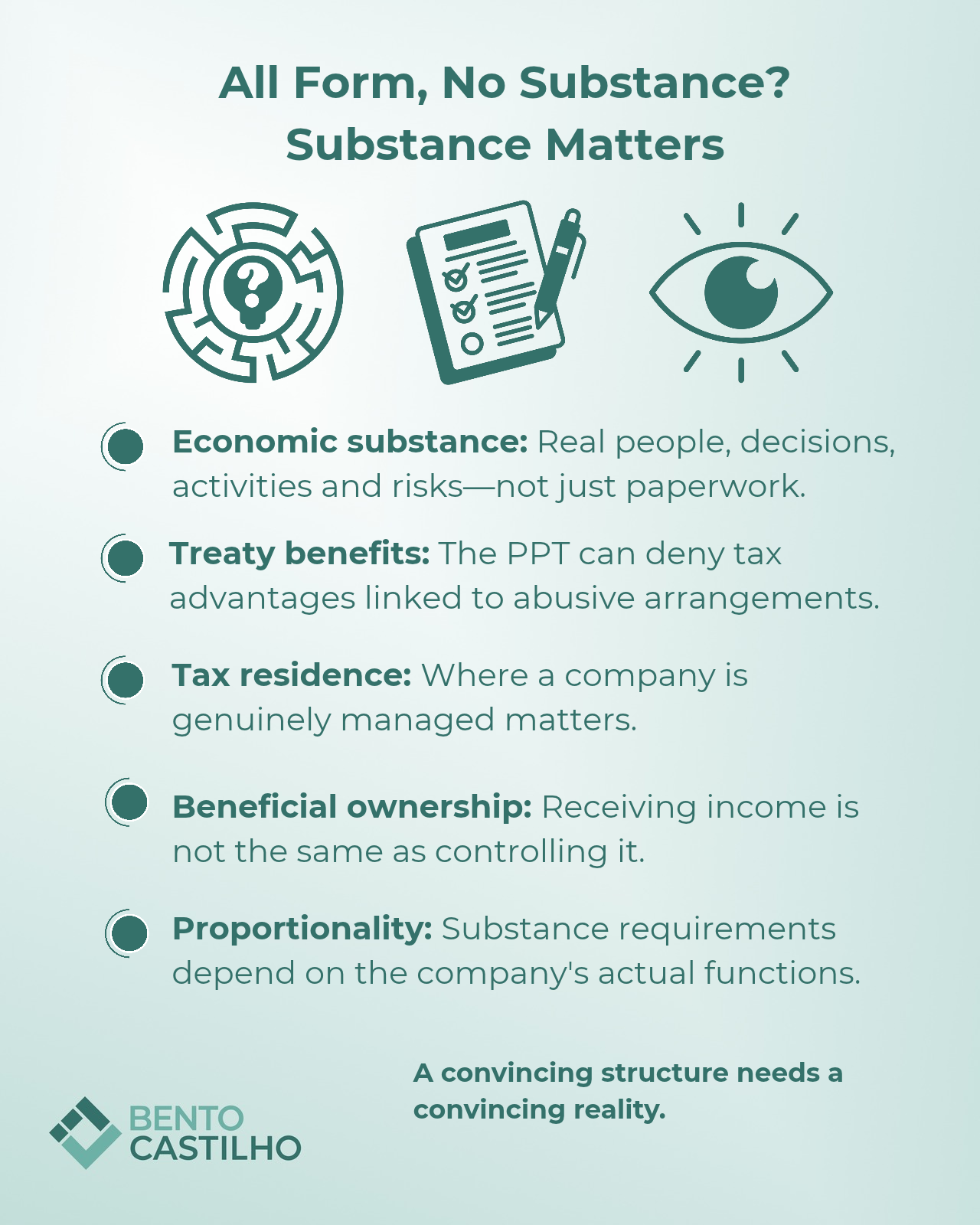
All Form, No Substance? Substance Matters
Because a company needs more than a registered address and a convincing PowerPoint.
In international tax law, substance is one of those concepts everyone talks about, but few define in quite the same way.
Tax authorities want it. Advisers assess it. Multinational groups spend considerable time documenting it. Yet there is no single, universally accepted legal definition of economic substance.
At its core, the question is straightforward: does a company’s economic reality support the tax treatment it claims?
The answer, inevitably, is more complicated.
Substance: More Than a Brass Plate
A company may be properly incorporated, have a registered office, maintain bank accounts and comply with every corporate filing requirement. That does not necessarily mean it has sufficient substance for international tax purposes.
What matters is whether the entity genuinely performs the functions, makes the decisions and assumes the risks attributed to it.
In practice, substance often comes down to four questions:
• People: Who actually performs the relevant activities?
• Decisions: Where are the important decisions made, and by whom?
• Premises: Does the company have facilities appropriate to its business?
• Risks: Does it genuinely control and bear the risks it claims to assume?
These are indicators, not a universal checklist. A holding company does not need the infrastructure of a manufacturing business. Equally, a company claiming to manage substantial commercial risks should be able to demonstrate more than an impressive organisational chart.
Substance must be proportionate to what the company actually does.
Why Does Substance Matter?
Substance becomes particularly important when a company seeks favourable treatment under international tax rules. Three areas deserve special attention.
1. Tax Residence: Where Is the Company Really Managed?
A company’s place of incorporation and its place of effective management are not necessarily the same. Depending on the applicable domestic rules and tax treaty, authorities may examine where strategic decisions are genuinely taken, rather than simply where board minutes say they were taken.
A board meeting abroad is useful evidence. It is less persuasive if all decisions were effectively made elsewhere before anyone entered the room.
2. Treaty Benefits: Is the Structure Entitled to Relief?
Tax treaties can reduce withholding taxes on dividends, interest and royalties. But access to those benefits is not unconditional.
The OECD’s Base Erosion and Profit Shifting (BEPS) project strengthened anti-abuse measures, particularly through Action 6 and the Principal Purpose Test (PPT).
Broadly, the PPT can deny a treaty benefit where obtaining that benefit was one of the principal purposes of an arrangement, unless granting it would be consistent with the object and purpose of the relevant treaty provisions.
Importantly, the PPT is not a standalone substance test. Genuine commercial activity can support a taxpayer’s position, but substance alone does not automatically settle the PPT analysis.
3. Beneficial Ownership: Who Really Enjoys the Income?
For certain treaty benefits, the recipient must qualify as the beneficial owner of the relevant income. The central question is whether that recipient has the right to use and enjoy the income without being constrained by an obligation to pass it on.
A company is not necessarily disqualified merely because it distributes profits to its shareholders. The analysis concerns its rights and obligations in relation to the specific income received.
In other words, receiving the money is one thing. Having genuine control over it is another.
How Much Substance Is Enough?
Perhaps the most useful answer is also the least satisfying: it depends on the company’s function.
A pure holding company may legitimately operate with limited personnel and infrastructure. Its relevant activities might consist primarily of evaluating investments, exercising shareholder rights and making strategic decisions.
An operating company, by contrast, may require employees, equipment, premises and operational capabilities commensurate with its business.
The broader lesson is that substance should be assessed against the actual business model, not an imaginary standard under which every entity must resemble a fully staffed corporate headquarters.
How Can Companies Demonstrate Substance?
Good substance documentation should tell a coherent story, supported by evidence. That may include:
• Board records showing genuine consideration and decision-making.
• Evidence of directors’ and employees’ actual responsibilities.
• Contracts, correspondence and records of commercial activities.
• Financial evidence demonstrating control over income and risks.
• Premises, resources and outsourced arrangements appropriate to the entity’s functions.
Outsourcing is not necessarily inconsistent with substance. The critical issue is whether the company retains appropriate oversight and decision-making capacity.
And documentation should reflect what actually happens. A beautifully drafted set of board minutes cannot manufacture a decision that was never made.
The Bottom Line
Substance is not about ticking the greatest number of boxes. Nor is it about maintaining the largest office, employing the most people or holding the most board meetings.
It is about ensuring that legal form, economic activity and tax treatment tell a consistent story.
Different tax rules ask different questions. Tax residence, beneficial ownership, the PPT and substantial-activity requirements are related, but they are not interchangeable.
The most defensible international structures are therefore not necessarily the most elaborate. They are the ones whose commercial reality can withstand scrutiny.
Because when the tax authorities look beyond the paperwork, there should be something worth finding.