Not All Dividends Are Created Equal: Asymmetric Dividends in Portugal
Legal requirements, tax treatment and participation exemption risks
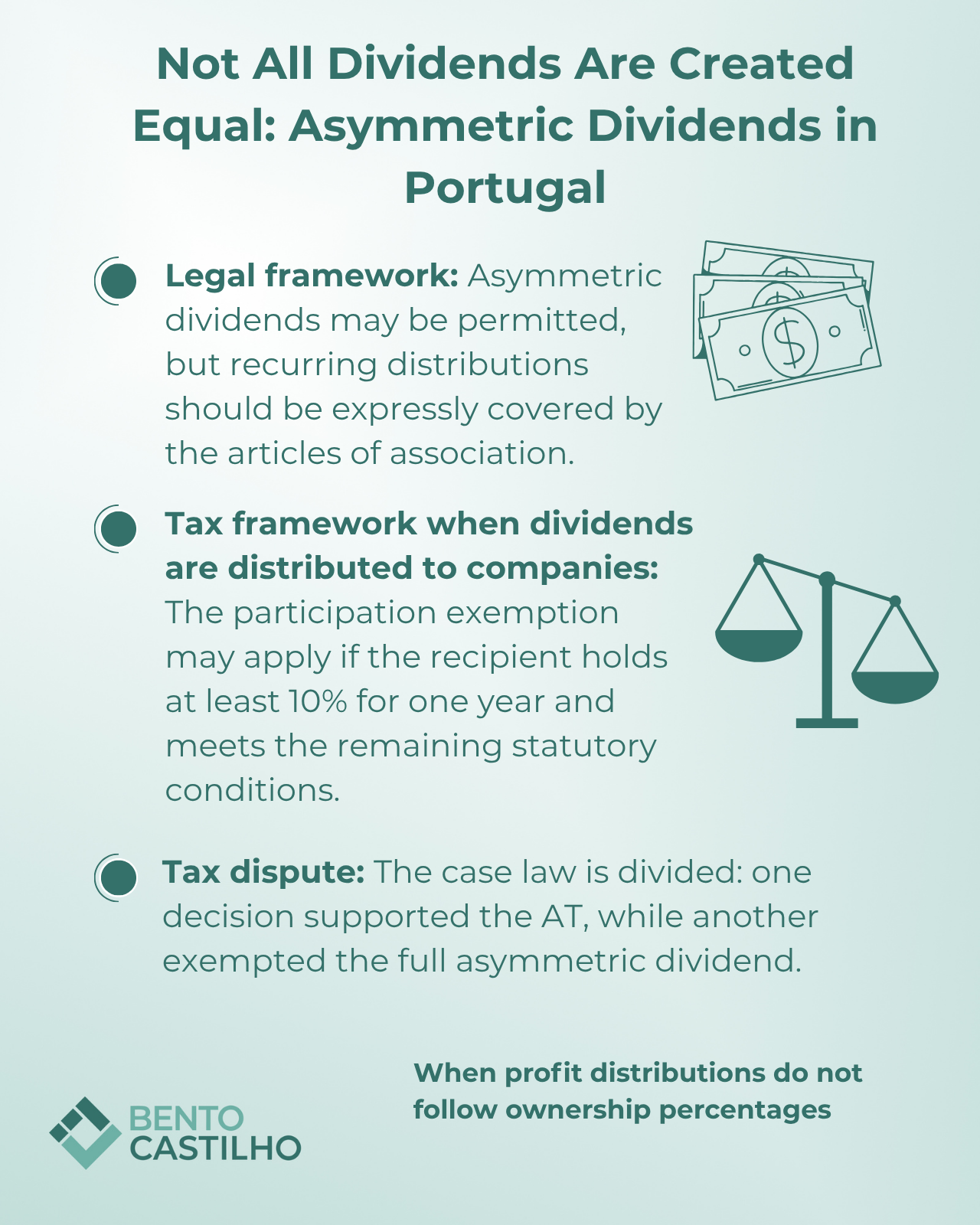
Portuguese companies may distribute profits in proportions that differ from their shareholders’ ownership. The arrangement must be valid under company law, and the tax result depends on who receives the dividend and how the asymmetry is created. For corporate shareholders, the Portuguese Tax Authority may challenge the participation exemption on the amount exceeding the recipient’s pro-rata entitlement.
What are asymmetric dividends
An asymmetric or disproportionate dividend is a profit distribution that does not follow the shareholders’ percentages in the company. A shareholder holding 30% of the capital may, for example, receive 50% of a particular distribution.
The structure matters. The company may allocate the profit a symmetrically from the outset, or a shareholder may first become entitled to a pro-rata dividend and later waive or assign that right to another shareholder.The second route creates a greater risk that the additional amount will be treated as a transfer between shareholders rather than as a dividend paid by the company.
Company law requirements
Article 22(1) of the Portuguese Companies Code establishes proportional participation in profits as the default rule, unless a special provision or contrary agreement applies. Any distribution must also comply with the capital-maintenance rules in Articles 31 to 33. In particular, the company cannot distribute amounts that would reduce net equity below share capital and reserves that cannot legally be distributed.
The legal reserve is a separate requirement. As a generalrule, at least 5% of annual profits is allocated to that reserve until theapplicable statutory threshold is reached, commonly 20% of share capital,subject to the rules for the relevant company type.
Private limited companies
For a sociedade por quotas or Lda., there is support for a unanimous, one-off asymmetric distribution. All affected shareholders should consent, the resolution should allocate the profit directly, and the arrangement must not exclude a shareholder unlawfully from participation in profits. If the preference is intended to recur, including it in the articles of association is safer.
Public limited companies
For a sociedade anónima or S.A., unequal economic rights arenormally established in the articles and attached to a class of shares, such aspreference shares. Although some legal commentary accepts unanimous ad hocdepartures, an amendment to the articles is the more defensible route forrecurring or material asymmetry.
Tax treatment at a glance
Dividends paid to individuals
Dividends paid by a Portuguese company to a Portuguese-resident individual are generally subject to final withholding tax at 28% under Article 71 CIRS. The rate applies to the gross amount allocated to the individual, whether the distribution is proportional or asymmetric.
The recipient may elect to aggregate the dividend with other taxable income. If Article 40-A CIRS applies, only 50% of the dividend isincluded in the tax base, and the withholding becomes a payment on account.Whether aggregation is advantageous depends on the individual’s overall income.
A non-resident individual is also generally subject to 28% final withholding. A double tax treaty may reduce that rate if the recipient proves residence and beneficial ownership in the required form.
If one shareholder first acquires a dividend right and thengives it to another individual, the transfer may require separate analysis,including possible Stamp Duty. The documentation should therefore show whetherthe company allocated the dividend asymmetrically or a shareholder transferredan existing right.
Dividends paid to companies
Portuguese resident companies
A dividend received by a Portuguese company may be excluded from taxable profit under the participation exemption in Article 51 CIRC. The principal conditions include a holding of at least 10% of the capital or voting rights, an uninterrupted holding period of one year, qualifying tax status for the distributing company, and residence outside a listed low-tax jurisdiction. The regime also contains anti-abuse and anti-hybrid restrictions.
Non resident companies
Dividends paid to a non-resident company without a Portuguese permanent establishment are generally subject to 25% final withholding. Article 14 CIRC may exempt a qualifying EU or eligible EEA parent with a direct holding of at least 10% for one uninterrupted year. A double tax treaty may otherwise reduce the rate. Residence, beneficial ownership, the holding period and the prescribed evidence must be established before relief is applied.
The Tax Authority position on asymmetric dividends
In the two relevant CAAD cases, the Portuguese Tax Authority took the same core position: the participation exemption should apply only to the part of the distribution corresponding to the recipient’s ownership percentage. According to the AT, the excess is not a dividend arising from that shareholder’s own participation and should therefore enter taxable profit.
In Case 352/2021-T, a 70% shareholder received the entire distribution after two 15% shareholders waived their amounts. The tribunal agreed with the AT. It treated the additional 30% as arising from the other shareholders’ waiver or assignment and considered that a different profit-sharing rule should have been included in the articles.
In Case 704/2021-T, the AT again attempted to limit the exemption to the recipient’s 50% holding, even though that shareholder received 90% and 84% of the profits distributed for the relevant periods. This time the tribunal rejected the AT’s position. The asymmetric entitlement was provided for in the foreign subsidiary’s constitutional document, and the tribunal held that Article 51 does not limit exempt dividends to the ownership percentage.
What companies should expect
The favourable decision does not bind the AT in other cases.Companies should therefore expect the AT to examine the portion exceeding therecipient’s pro-rata entitlement, particularly where the asymmetry results froman annual waiver, lacks a clear commercial reason, or is not supported by thearticles of association. An inspection may lead to the excess being added totaxable profit, leaving the company to challenge the correction throughadministrative or judicial proceedings.
The taxpayer has a stronger position where the company’sconstitutional documents permit asymmetric distributions, the shareholders’resolution allocates the profit directly, and the arrangement has a documentedcommercial rationale. Even then, the outcome is not settled. For a material orrecurring distribution, an amendment to the articles and a binding tax rulingshould be considered before payment.
Conclusion
Asymmetric dividends can be implemented in Portugal, but they should not be approached as a simple variation of an ordinary dividend.The legal basis for departing from proportionality must be established under the CSC, and the distribution must satisfy the usual capital-protection rules. The tax result then depends on the recipient and on how the economic shift is legally created.
For individuals, the ordinary 28% dividend withholding framework generally remains the starting point. For companies, the decisive issue is often whether the participation exemption and the related withholding relief are available. The conflicting CAAD decisions show why an entitlement built into the company's constitutional arrangements is materially stronger than an informal or annual waiver by another shareholder.