De Facto Union in Portugal: Advantages and Disadvantages Under Portuguese Law
What unmarried couples in Portugal need to know about their rights — and the gaps marriage would cover.
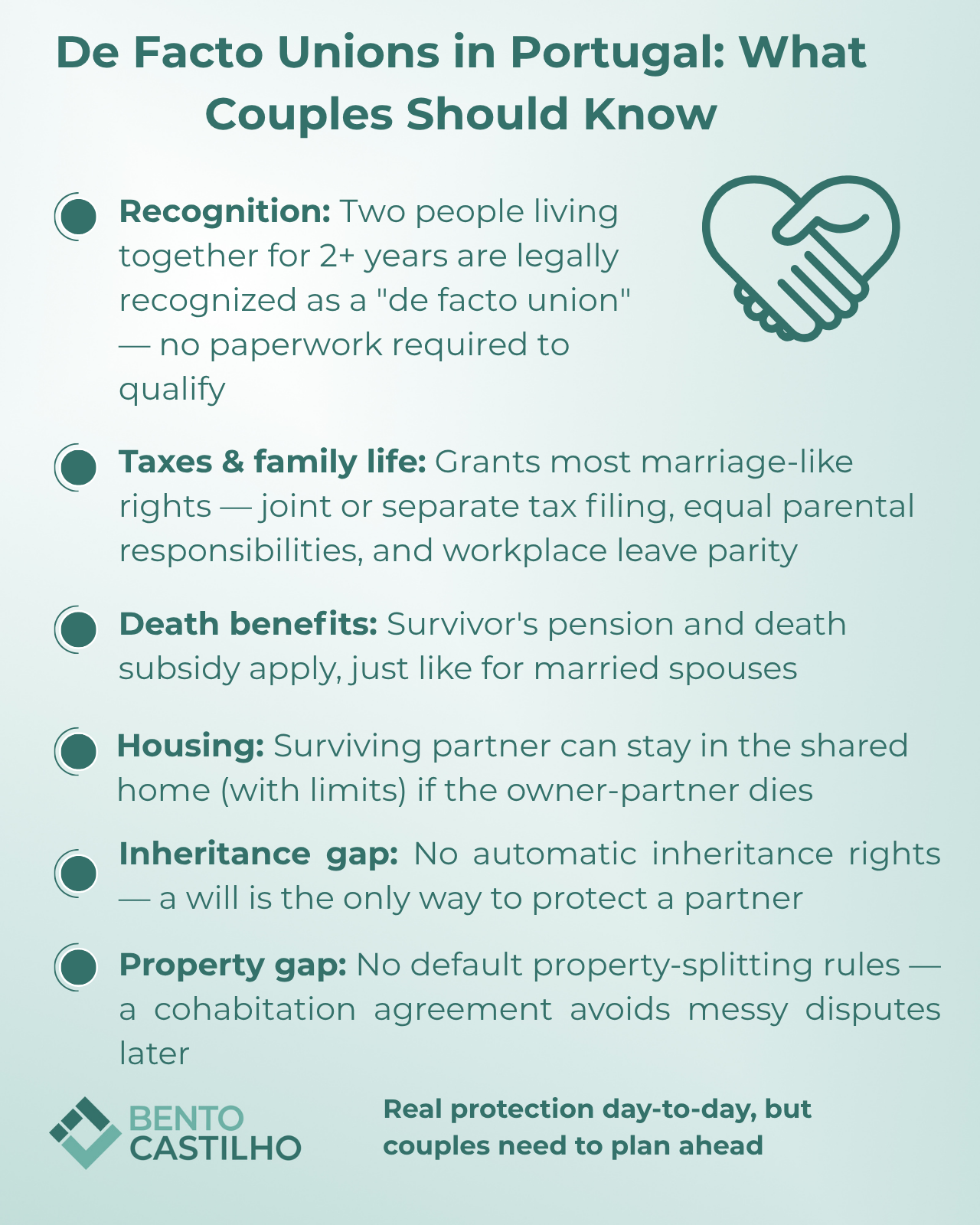
De Facto Union in Portugal: Advantages and Disadvantages Under Portuguese Law
Living together as a couple without getting married isincreasingly common in Portugal, and the law has a specific name and a specificset of rules for it: união de facto, or "de facto union."It gives unmarried couples many of the legal protections of marriage, but notall of them, and the gaps can matter a great deal if a relationship ends or apartner passes away.
Whether you are already living with a partner in Portugal orconsidering it, here is what the law actually says about de facto unions, howthe relationship is proven, and the concrete advantages and disadvantagescompared with marriage.
What Is a De Facto Union Under Portuguese Law?
Portuguese law defines a de facto union as the legal situation of two people, regardless of sex, who have lived together inconditions similar to those of spouses for more than two years.
To be legally recognised, the couple must also meet a number of conditions. Both partners must be over 18. Neither can be affected by amental incapacity that would have prevented the union from being validly formed. They cannot be closely related by blood (in the direct line, or as siblings). Neither can be married to someone else at the time, unless that earlier marriage ended in a legal separation of persons and property. And neither partner can have been convicted of intentionally killing the other's former spouse. Meet all of these conditions for at least two years, and you are, in the eyes of the law, in a de facto union.
How Do You Prove a De Facto Union?
Because there is no marriage certificate to point to, a de facto union has to be evidenced in other ways when it matters — for a tax return, a pension claim, an inheritance dispute, or an immigration process, for example.
The simplest route runs through the tax authorities. Since2015, when both partners have registered the same fiscal address (domicílio fiscal) for at least two years and during the relevant tax period, this creates a presumption of a de facto union whenever the couple invokes it. Matching addresses are not, however, a mandatory requirement: the union can equally be proven by any other admissible means, such as:
- A parish council declaration: a statement issued by the local junta de freguesia, accompanied by a sworn declaration from two neighbours confirming they have lived together for more than two years, together with full copies of each partner's birth certificate.
- Children in common: a shared child is generally accepted as evidence of the relationship.
The Legal Advantages of a De Facto Union
Once recognised, a de facto union brings couples close to parity with marriage in several important areas.
Flexibility on income tax
Couples in a de facto union can choose to file their IRSreturn jointly or separately, whichever works out better for them. It is worthrunning the numbers both ways each year, since the more favourable option canchange with income levels and family circumstances.
Equal parental responsibilities
Parents in a de facto union have exactly the same rights and duties toward their children as married parents: the obligation to raise,support, and safeguard the health and safety of children until adulthood. If the couple separates, custody, child maintenance, and related costs are handled under the same rules that apply to divorcing parents.
Equal treatment in the workplace
Partners in a de facto union who work for the same employer are entitled to the same treatment as married colleagues when it comes to holidays, leave, absences, and public holidays.
Death subsidy and survivor's pension
If one partner dies, the survivor is entitled to a death subsidy and a survivor's pension from Social Security, on the same basis as a surviving spouse. Depending on the circumstances, they may also be entitled tobenefits arising from an occupational illness or compensation for a workplace accident. In every case, proof of the de facto union will need to be presented to unlock these entitlements.
The right to remain in the home
If the partner who owned the shared home dies, the survivor generally has the right to go on living there for at least five years, provided they have no home of their own. Where the union lasted longer than five years, that right can extend to match the length of the relationship. Once that period ends, the survivor can usually stay on as a paying tenant at market rent, and generally has first refusal to buy the property if it is ever sold.
The rules are different when the home was rented rather than owned. If the deceased partner was the one on the lease, the tenancy passes directly to the surviving partner, who simply becomes the new tenant — provided the couple had been living together for at least a year. This right does not apply if the survivor already owns or rents another home in the same area.
Adoption rights
Couples in a de facto union of more than four years may adopt a child together. These adoption rights apply regardless of the sex of the partners — same-sex and different-sex couples in a qualifying de factounion are treated alike.
A simpler way to separate
Ending a de facto union is considerably less formal than a divorce. It can happen through death, the marriage of one partner to someone else, or simply the will of one or both partners to end it. In practice, a signed declaration stating the date the relationship ended is generally enough— and, unlike marriage, only one partner needs to sign it.
The Disadvantages: Where a De Facto Union Falls Short of Marriage
Many couples choose a de facto union precisely because it is less binding than marriage — but that same flexibility creates gaps that are worth understanding before relying on it, particularly around money and property.
No automatic right of inheritance
This is the single biggest difference from marriage. A surviving partner in a de facto union is not a legal heir. The only way to inherit from a partner is through a valid will that leaves them all or part of the estate the law allows to be freely disposed of. Without one, the survivor can walk away with nothing from the estate itself, whatever benefits and housing rights described above they may separately be entitled to.
No statutory regime for dividing property
Marriage in Portugal comes with a property regime that determines, by law, how assets are split if the marriage ends. A de facto union has no equivalent. When the relationship ends, property acquired together isdivided under the ordinary rules of co-ownership — broadly, in proportion to what each partner actually contributed toward buying it, which is not always easy to prove and does not always feel fair. Couples who want more certaintycan put a cohabitation agreement in place in advance, setting out how assets would be divided if they were to separate.
Paternity is not automatic
For a married couple, the law automatically presumes the husband is the father of a child born during the marriage. In a de facto union,there is no such presumption — the father must voluntarily acknowledgepaternity (perfilhação). Once that step is taken, however, the child's rightsare identical to those of a child born to married parents.
No legal duties of fidelity and mutual support
Marriage imposes specific legal duties on spouses — respect, fidelity, cohabitation, cooperation, and mutual assistance. None of these duties exist as a matter of law between partners in a de facto union. In practice this mainly matters if things go wrong: there is no legal breach to point to in the way there might be in a marriage.
No right to adopt the partner's surname
Married spouses may add their partner's surname to their own. Partners in a de facto union do not have this right.
Unjust enrichment disputes on separation
Without a prior agreement, disagreements over who contributed what to shared assets can escalate. If one partner ends up better off at the other's expense — for example, an asset registered in one partner'sname but paid for, in whole or in part, with the other's money — the disadvantaged partner may be able to claim unjust enrichment and seek reimbursement. These cases are often genuinely difficult to prove and, whenthey cannot be resolved between the couple, usually end up before a judge.
Marriage or De Facto Union: What Should You Consider?
Neither option is objectively "better" — it depends on what a couple wants from their relationship and how much legal certainty they need. A de facto union offers real protections in areas like tax, parenting, employment, and social security, along with a far simpler exit if things do not work out. What it does not offer is the automatic inheritance rights and default property regime that come with marriage.
For couples who choose to live in a de facto union, the practical safeguard is to put in writing, while things are going well, what would happen to shared property and finances if the relationship were to end —and to consider a will if leaving something to a partner matters to either of you. A conversation now, formalised with the right legal advice, is far easier than resolving these questions later without one.