Divorce in Portugal: Can Unpaid Domestic Work Give Rise to Financial Compensation?
When a marriage ends, financial discussions begin.
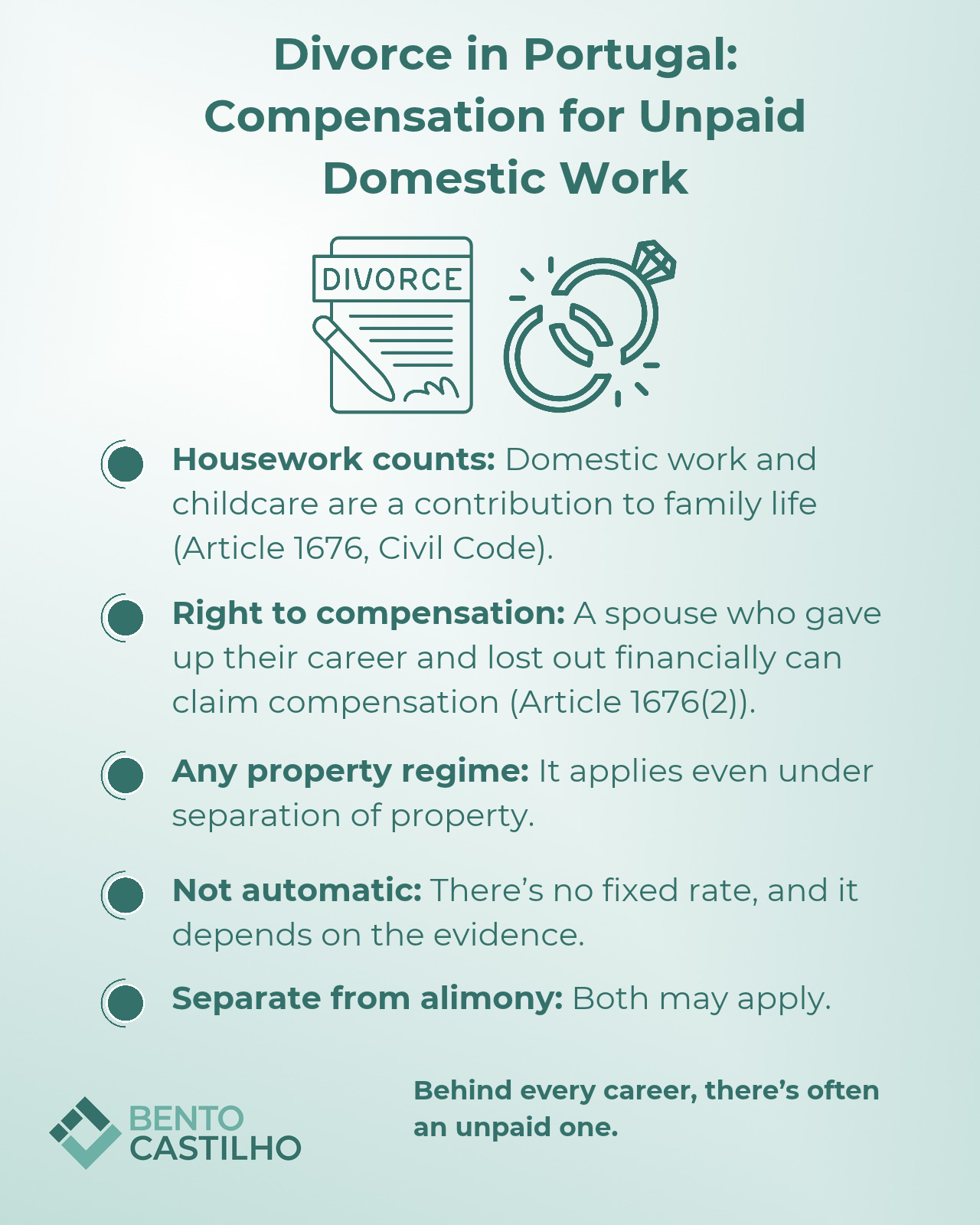
If you gave up or scaled back your career to look after your home and children, you may be entitled to financial compensation when your marriage ends. Portuguese law recognises that unpaid work at home has real economic value – and the courts are increasingly putting a figure on it.
Key points
- Housework and childcare count as a contribution to family life, just like a salary.
- A spouse who contributed far more than their share and lost out financially as a result can claim compensation under Article 1676(2) of the Civil Code.
- This can apply whatever your property regime, including separation of property.
- It is not automatic and there is no fixed rate. Each case depends on its evidence.
- It is separate from alimony – you may be entitled to both.
- Recent court decisions have awarded tens of thousands of euros.
What does the law say?
Under Article 1676 of the Portuguese Civil Code, both spouses must contribute to family expenses according to their means. You can do this with money or with work in the home and the care of your children.
Article 1676(2) goes further. It gives a spouse the right to compensation from the other where all three of the following apply:
- you contributed considerably more than you were required to;
- you did so by excessively giving up your own interests – especially your career – for the sake of family life; and
- you suffered significant financial loss as a result.
Simply doing more of the housework is not enough. The claim is about what it cost you: the career, income and pension you gave up.
Who may have a claim?
Typical situations include:
- You stopped working, or cut back substantially, to look after the children or the home.
- Family responsibilities held back your promotion, training or business.
- You carried almost all of the housework and childcare for many years.
- You are now significantly worse off – in income, savings or pension.
The court will also look at how long the marriage lasted, how the couple organised their finances and what opportunities each spouse had.
Does it matter how you are married?
Most couples in Portugal who marry without a prenuptial agreement are under the community of acquired property regime (comunhão de adquiridos). Others choose separation of property (separação de bens).
Compensation under Article 1676(2) is a personal claim between the spouses, separate from the division of assets. That means it can arise under any regime – including separation of property, where many people assume nothing is owed.
The regime does affect when you can claim:
- Community regimes: the claim is made when the couple’s assets are divided (partilha), not in the divorce itself. The courts have confirmed this (Guimarães Court of Appeal, 2011; Porto Court of Appeal, 2024).
- Separation of property: you do not have to wait for a division of assets.
Keep in mind that compensation is a claim to money, not to your spouse’s property. And if your marriage has links to another country, check first which country’s law applies.
What have the courts decided?
Supreme Court of Justice, 14 January 2021: around €60,000
An unmarried couple lived together for about 30 years. She did all the housework and worked unpaid in his business while he built up his property dealings. The Supreme Court (Case No. 1142/11.2TBBCL.1.G1.S1) confirmed an award of around €60,000.
The amount was set on equitable grounds: the national minimum wage × 12 months × the years together, less one-third for her own living costs. Because the couple were not married, the claim was based on unjust enrichment rather than Article 1676(2), but the message is the same: unpaid work at home has value.
Coimbra Court of Appeal, July 2026: €45,000
A couple married in 2002 and separated in 2017. For 15 years the wife devoted herself almost entirely to the home and their daughter, while the husband worked full-time and paid the mortgage. The court in Leiria refused her any compensation and ordered her to pay half of the mortgage costs.
The Court of Appeal reversed that decision. It awarded her €45,000 for her domestic work and childcare, and held that making her pay half the mortgage for the years of the marriage was a clear breach of good faith. In the court’s words (our translation):
Domestic work has an undeniable economic value. The exclusive or predominant dedication of one spouse to the home creates a financial imbalance between them.
Both decisions show the courts looking at the economic reality of a relationship, not just whose name is on the title deeds or the bank account.
How is compensation calculated?
The law sets no formula and no fixed rate. The court considers how much of the domestic work you carried, how long the sacrifice lasted, the financial loss you suffered and how the couple organised their finances. It may then fix the amount on equitable grounds. The minimum wage method used by the Supreme Court is a useful reference, not a binding rule.
Compensation is not simply what it would have cost to hire a housekeeper or a nanny. It reflects your particular contribution and the loss you can prove.
Evidence that can help:
- employment contracts and records;
- income and tax history before, during and after any career break;
- qualifications and evidence of your career path;
- records of when and why you stopped or reduced work;
- who handled childcare and the household, and whether there was regular paid help.
Is this the same as alimony?
No. They are separate claims:
- Compensation looks back. It makes up for what you gave up during the marriage.
- Alimony (also called spousal maintenance) looks forward. It supports a former spouse who cannot provide for themselves, and the starting point in Portuguese law is that each former spouse should be self-sufficient.
- Division of property splits the assets the couple owns together.
Depending on your situation, more than one of these may apply in the same divorce.
The bottom line
A contribution to a marriage is not measured only in salaries and property. If you put your family ahead of your career and are significantly worse off because of it, Portuguese law may allow you to recover part of that loss – whatever your property regime. Because compensation is never automatic, it is worth understanding your position early, before the assets are divided.
This article provides general information only and does not constitute legal advice.