Die Another Day: The US Estate Tax Trap Many Europeans Don't Know About
How US estate tax can unexpectedly affect Portugal-based investors holding US shares.
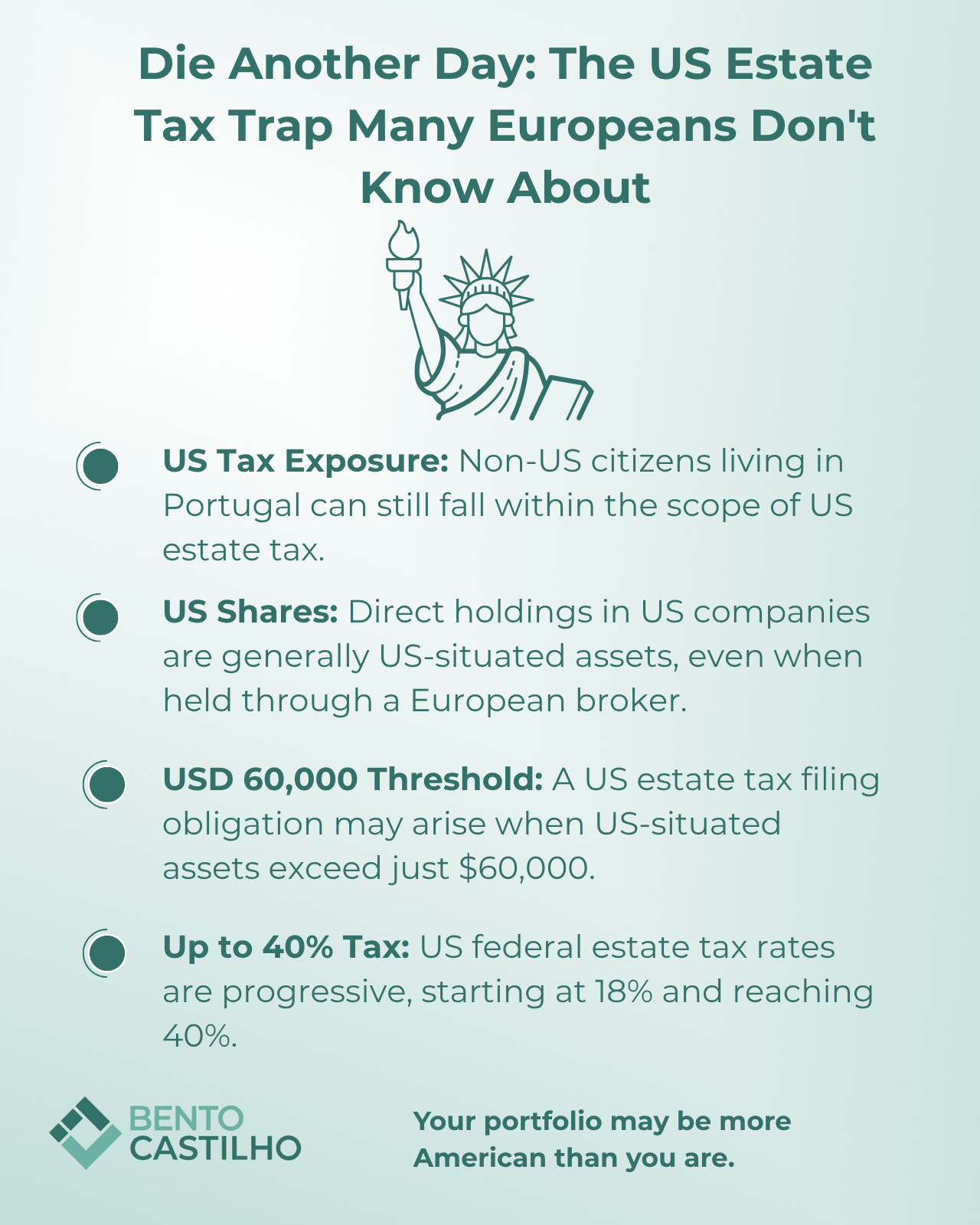
Why an ordinary portfolio of US shares can create an unexpected US estate tax liability
For an investor living in Portugal, holding shares incompanies such as Apple, Microsoft, Alphabet or Berkshire Hathaway may seementirely unremarkable.
The investor may have no meaningful connection with the United States: no US citizenship, no US residence, no green card and perhaps not even a US bank or brokerage account.
Yet direct ownership of shares in US companies can create an exposure to US federal estate tax on death.
The reason is an important feature of the US estate tax regime: for individuals who are neither US citizens nor US domiciled, the United States can impose estate tax based not on where the individual lives, but on whether they own US-situated assets.
For internationally invested families in Portugal, this is an issue worth identifying well before it becomes an estate administration problem.
The US estate tax reach extends beyond US citizens
US estate tax operates differently depending on the status of the deceased.
For a person who is neither a US citizen nor considered domiciled in the United States for estate tax purposes, the US generally limits its estate tax jurisdiction to assets regarded as situated in the United States.
This makes the concept of asset situs particularly important.
A person can therefore live permanently in Portugal and remain outside the US tax system for most purposes, while still owningindividual assets that fall within the scope of US estate tax.
US shares are a key example
Shares issued by corporations organised in the United Statesare generally treated as US-situated property for US estate tax purposes.
This can include direct investments in many of the world'smost widely held companies, such as:
- Apple
- Microsoft
- Alphabet
- Amazon
- Nvidia
- Berkshire Hathaway
Importantly, the location of the investor's brokerageaccount does not generally determine the situs of the shares.
Holding Microsoft shares through a Portuguese, Swiss or Luxembourg financial institution does not turn Microsoft into a non-US company.For estate tax purposes, the relevant consideration is generally the nature and situs of the underlying asset.
That distinction is easy to overlook.
The significance of the $60,000 threshold
The issue becomes particularly important because thethreshold applicable to estates of non-US citizens who are not US domiciled isconsiderably lower than many investors expect.
A US estate tax filing obligation may arise where the value of the deceased's US-situated assets, together with certain relevant taxable gifts, exceeds $60,000 at the date of death.
The $60,000 threshold is fixed and is not indexed for inflation.
This means that US estate tax is not exclusively an issue for exceptionally wealthy families.
A relatively conventional investment portfolio can be sufficient to bring an estate within the US filing regime.
US federal estate tax rates are progressive starting at 18% and can reach 40%. The actual tax liability, however, requires a proper calculation taking account of the taxable estate, available deductions, credits and the circumstances of the individual estate.
It is better understood as a warning point: acomparatively modest amount of US-situated property can create a US estate taxfiling requirement and potentially a material tax liability.
An example: a Portuguese investor with a global portfolio.
Consider a Portuguese citizen who has lived in Portugalthroughout her life and has never been a US citizen or US domiciliary.
His or Her estate includes:
- A home in Portugal;
- Portuguese bank deposits;
- European investments; and
- €100,000 of directly held shares in Apple, Microsoft and Berkshire Hathaway.
The investments are managed through a European financial institution.
From the investor's perspective, this may simply be one diversified European-held portfolio.
From a US estate tax perspective, however, the analysis is different.
The Portuguese property and other non-US assets would generally fall outside the US estate tax net applicable to a non-USdomiciliary. The directly held shares in US corporations, by contrast, aregenerally treated as US-situated property.
On his or her death, those holdings could therefore giverise to a US estate tax filing obligation and, depending on the circumstances,a US estate tax liability.
The relevant estate tax return is generally Form 706-NA.
Does the US–Portugal tax treaty provide protection?
This is another area where assumptions can be misleading.
The United States and Portugal have a bilateral income tax treaty, but Portugal does not currently have an estate or estate-and-gift tax treaty with the United States.
That distinction is important.
The United States has estate tax treaties with a limitednumber of countries, but not with Portugal. Depending on the treaty, these canmaterially alter the application of domestic US estate tax rules.
Why this matters for families in Portugal
For families based in Portugal, direct investments in USsecurities are a good illustration of why this matters.
An individual may have organised their personal and financial affairs entirely in Portugal while unintentionally accumulating a substantial portfolio of assets over which the United States asserts estate tax jurisdiction.
The issue may remain invisible during the investor's lifetime and only emerge when executors and beneficiaries begin administering the estate.
Points to review
Individuals and families in Portugal may wish to review their position where a non-US citizen who is not US domiciled holds:
- shares directly in US corporations;
- US real estate;
- substantial US investment portfolios; or
- other assets potentially classified as US-situated for estate tax purposes.
Particular attention should be paid where the aggregatevalue of relevant US assets approaches or exceeds $60,000.
The review should consider not only whether a filing obligation exists, but also the ownership structure, potential estate tax exposure, interaction with Portuguese succession and tax rules, and whether any planning should be undertaken during the owner's lifetime.
The key takeaway
You do not need to be American, live in America or use anAmerican broker to have a US estate tax problem.
For a non-US citizen who is not US domiciled, direct ownership of US-situated assets can be enough.
And because the relevant filing threshold can be just $60,000 of US-situated assets, the issue is not confined to ultra-high-net-worth families.
For residents of Portugal with international investment portfolios, identifying US-situated assets should therefore be a standard part of cross-border estate planning.