One Share, Two Masters: The Usufruct of Shares
Rights of the usufructuary vs bare owner explained
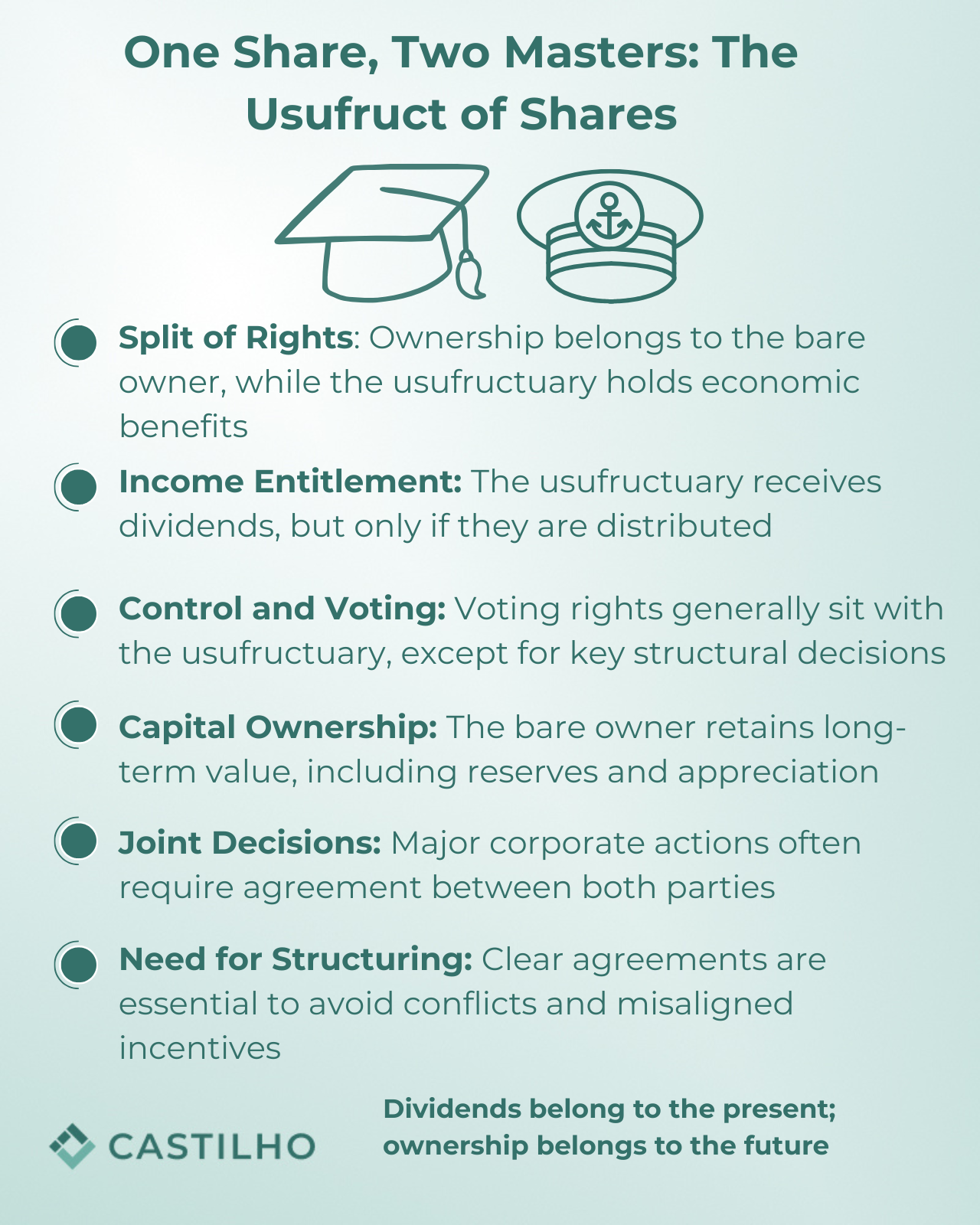
One Share, Two Masters: The Usufruct of Shares
The usufruct of shares remains one of the mostsophisticated—yet underused—tools in corporate and succession planning. Sitting at the intersection of civil law and company law, it allows a separation between ownership and economic enjoyment, creating flexible but complex legal relationships.
This article explains how usufruct of shares is structured,how rights are allocated between the usufructuary and the bare owner, and why careful drafting is essential in practice.
1. What is the Usufruct of Shares?
A usufruct is a real right of enjoyment that allows its holder (the usufructuary) to use and benefit from an asset belonging to another (the bare owner), without altering its substance.
Applied to shares, this means:
- The usufructuary receives the economic benefits (e.g. dividends)
- The bare owner retains ownership and long-term value
This creates a split between:
- Income rights (short-term)
- Capital rights (long-term)
2. How is the Usufruct of Shares Set Up?
2.1 Creation of the Usufruct
The usufruct of shares may be created through:
- Contract (most common)
- Donation (e.g. parents transferring shares while keeping income)
- Testament
In practice, it is typically established as part of
- Succession planning
- Family business structuring
- Investment arrangements
2.2 Corporate Law Requirements
Because shares are corporate instruments, the creation of usufruct must comply with company law rules.
Key requirements includ
- Written form
- Consent (in some cases, from the company or other shareholders)
- Recognition by the company
- Registration (commercial registry or securities account)
Without proper registration or recognition, the usufruct maynot be enforceable against the company.
2.3 The Role of the Usufruct Agreement
A critical point:
The legal regime is largely default (suppletive)—but the outcome depends on the usufruct agreement.
The parties can (and should) define
- Who exercises voting rights
- How dividends are handled
- Participation in capital increases
- Allocation of liquidation proceeds
- Conflict resolution mechanisms
Without clear drafting, the parties fall back on legal defaults that may not reflect their intentions.
3. Rights of the Usufructuary
3.1 Right to Dividends
The usufructuary is entitled to
- Dividends distributed during the usufruct period
However:
- No right to profits generated before the usufruct
- No automatic right to retained earnings (reserves)
This is crucial:
Dividends only exist if shareholders decide to distribute them.
3.2 Voting Rights
As a general rule
- The usufructuary votes in general meetings
But for fundamental decisions (such as):
- Amendments to articles of association
- Dissolution of the company
Voting must be exercised jointly with the bare owner
3.3 Right to Participate in Liquidation
In case of liquidation
- The usufructuary is entitled to enjoy the value attributed to the shares during the usufruct period
3.4 Right to Information (in Certain Cases)
Where the usufructuary:
- Holds voting rights, or
- Is granted rights contractually
They may access company information necessary to exercise their rights.
3.5 Duty of Proper Management
The usufructuary must
- Act diligently (as a “prudent administrator”)
- Preserve the economic value of the shares
- Respect their purpose
They cannot
- Dispose of the shares
- Damage their value
4. Rights of the Bare Owner
4.1 Ownership and Capital Value
The bare owner retains
- Legal ownership of the shares
- The long-term economic value (capital appreciation)
4.2 Rights over Retained Earnings
Unlike dividends:
- Undistributed profits (reserves) benefit the bare owner
This reflects the distinction between:
- Income (usufructuary)
- Capital (bare owner)
4.3 Participation in Structural Decisions
The bare owner must participate in:
- Changes to statutes
- Dissolution
These require joint decision-making.
4.4 Rights in Capital Increases
Depending on agreement:
- Bare owner and usufructuary may:
- Share participation rights
- Allocate new shares differently
- Decide who exercises pre-emption rights
4.5 Protection Against Misuse
If the usufructuary acts improperly, the bare owner may:
- Claim damages
- Request judicial intervention
- In serious cases, seek transfer of control rights
For example, courts may:
- Transfer effective control (e.g. voting) to the bare owner
- While preserving the usufructuary’s income rights
5. A Tool Worth Rediscovering
Despite its complexity, usufruct of shares offers clear advantages:
- Flexibility in separating income and ownership
- Strong legal protection as a real right
- Usefulness in:
- Family business succession
- Wealth planning
- Investment structuring
Its under use reflects complexity—not lack of utility.